Internal Rate Of Return (IRR) Calculator & Usage
Apr 10, 2019 · 3 min read
An internal rate of return (IRR) is a calculation investors use to determine the likely rate of growth of capital (as it relates to both time and yield) for a particular commercial real estate investment opportunity.
What is IRR: Internal Rate of Return?
The internal rate of return (IRR) is one of the most important metrics in commercial real estate finance. It represents the percentage rate earned on each dollar invested for each period it is invested. IRR uses the concept of time value of money, which means that money an investor has now is more valuable than money an investor has later. Commercial property investors often calculate the IRR to compare different potential investments to determine what is the most profitable opportunity. All other things being equal, the potential investment with the largest IRR is the most lucrative venture.
Key takeaways
- The internal rate of return (IRR) is a key metric in commercial real estate finance, representing the percentage rate earned on each dollar invested for each period it is invested.
- IRR uses the concept of time value of money, which means that money an investor has now is more valuable than money an investor has later.
- Commercial property investors often calculate the IRR to compare different potential investments and determine which is the most profitable opportunity.
- The IRR formula is: IRR = (cash flow / net present value) x 100
IRR Calculator
IRR Calculator
–
Calculating the IRR is a common way to evaluate real estate projects of disparate sizes. For example, a $7 million investment that yields $21 million in return has a higher IRR than a $70 million investment that yields $140 million.
The IRR isn't a perfect calculation because it doesn't consider the cost of capital. Also, it can't be used to calculate the rate of return of different projects that don't have exits on the same time horizon. It also doesn't take into account the size of the rate of the return, which should impact the interest of an investor. For example, an investor can choose to invest $20 for a return of $100, which has a much higher IRR than an investment of $20 million for a return of $40 million. Finally, IRR also does not factor in the risk of an investment, which is extremely important to most commercial real estate investors.
The IRR formula
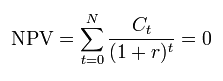
Where,
t = time,
C = cash flow,
r = internal rate of return, and
NPV = net present value.
Through this formula, we see that the IRR for any commercial real estate property investment is simply the percentage that brings the property's net present value (NPV) to zero. Both IRR and NPV can be used in discounted cash flow (DCF) analysis to determine the current value of a set of cash flows using a predetermined discount rate. That makes it easy for investors to compare the potential investment gains from a commercial property to the potential gains from another investment, such as a stock, bond, or a different piece of real estate.
IRR vs. Modified Internal Rate of Return (MIRR)
Modified internal rate of return, or MIRR, is a variant of IRR that takes into account the fact that a commercial real estate investor is likely reinvesting any positive cash flow they receive into a different investment. It uses the investor’s estimated rate of return on this reinvested cash, known as the “reinvestment rate” to calculate an new IRR, or “modified” IRR that will more accurately represent an investor’s overall return.
IRR vs. Equity Multiple
IRR is often compared with equity multiple, another essential commercial real estate metric. Equity multiple can be calculated using the formula:
Equity Multiple = Total Cash Distributions/Total Equity Invested
Unlike IRR, equity multiple does not incorporate the concept of time value of money. In general, equity multiple is a better way to determine the overall return of an investment over a longer period of time, while IRR may be a better way to calculate the return of a shorter-term commercial real estate investment.
IRR Final Thoughts
The internal rate of returns is a key metric when it comes time to defining the relationship between time and yield on a commercial real estate investment. It is most commonly used by investors that have sensitivity to velocity of capital such as merchant builders. Regardless of your investment goals, it's important to understand all the metrics as they relates to commercial real estate investment underwriting.
Want to learn more? Get a quote to speak with a commercial mortgage specialist.
Frequently asked questions
What is an Internal Rate of Return (IRR) calculator?
Internal Rate of Return (IRR) is a metric used by investors to estimate the profitability of potential investments. It is a measure of the percentage rate earned on each dollar invested, for each period it is invested. An IRR calculator is a tool used to calculate the internal rate of return of a given investment. It is commonly used by investors that have sensitivity to velocity of capital such as merchant builders.
Sources:
How is an Internal Rate of Return (IRR) calculator used?
An Internal Rate of Return (IRR) calculator is used to measure the annual rate of growth expected to be generated by an investment property. It is generally expressed as a percentage and is used by investors to estimate the profitability of potential investments. IRR is a measure of the percentage rate earned on each dollar invested, for each period it is invested.
What are the benefits of using an Internal Rate of Return (IRR) calculator?
The main benefit of using an Internal Rate of Return (IRR) calculator is that it allows investors to compare different potential investments and determine which one is the most profitable. It takes into account the concept of time value of money, which means that money an investor has now is more valuable than money an investor has later. This helps investors make more informed decisions when it comes to investing in commercial real estate. Additionally, IRR can be used to compare different loan products and determine which one is the most beneficial for the investor.
For more information, please see https://www.propertymetrics.com/blog/2014/06/09/what-is-irr/ and www.commercialrealestate.loans/commercial-real-estate-glossary/irr-internal-rate-of-return.
What are the drawbacks of using an Internal Rate of Return (IRR) calculator?
The Internal Rate of Return (IRR) calculator is not a perfect calculation because it doesn't consider the cost of capital. It also can't be used to calculate the rate of return of different projects that don't have exits on the same time horizon. It also doesn't take into account the size of the rate of the return, which should impact the interest of an investor. Finally, IRR also does not factor in the risk of an investment, which is extremely important to most commercial real estate investors.
SourceWhat are the different types of Internal Rate of Return (IRR) calculators?
There are two main types of Internal Rate of Return (IRR) calculators: commercial real estate and multifamily investment. Commercial real estate IRR calculators are used to define the relationship between time and yield on a commercial real estate investment. Multifamily investment IRR calculators are used to estimate the profitability of potential investments.
How can an Internal Rate of Return (IRR) calculator help with commercial real estate financing?
An Internal Rate of Return (IRR) calculator can help with commercial real estate financing by providing investors with a metric to compare different potential investments. The IRR is a percentage rate earned on each dollar invested for each period it is invested. It uses the concept of time value of money, which means that money an investor has now is more valuable than money an investor has later. By calculating the IRR, investors can determine which potential investment is the most profitable opportunity.
For more information, please see the following sources: